




Meet Dr. Jorge Cardenas, Westcliff University’s New Dean of the College of Business
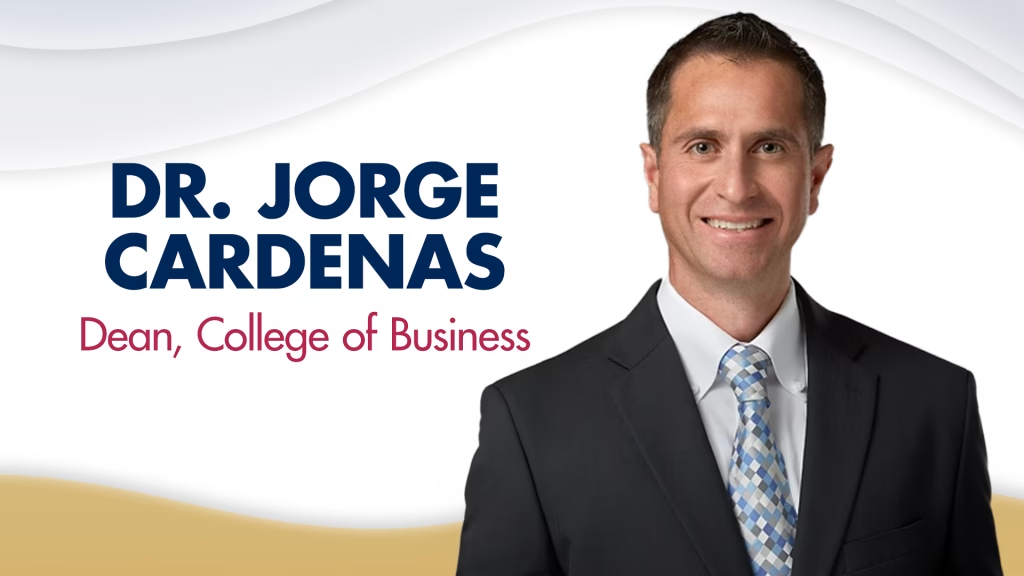
How applied learning and global business expertise are shaping the next chapter of Westcliff’s College of Business
In this article:
- Meet Dr. Jorge Cardenas, Westcliff University’s new Dean of the College of Business
- Learn how his global background shapes his approach to business education
- Explore the skills today’s MBA and DBA students need to succeed
- Understand how applied learning is guiding the future of the College of Business
Business no longer moves in straight lines.
Supply chains can shift overnight. Artificial intelligence now shapes marketing strategy and financial forecasting. Entrepreneurs launch scalable companies without ever stepping onto a traditional corporate ladder.
That is the environment today’s business students are entering—and it raises a critical question: what should you actually be learning to succeed in modern business?
According to Dr. Jorge Cardenas, Dean of the College of Business at Westcliff University, the answer goes far beyond course titles or rankings. It lies in how closely business education reflects real-world practice.
“Graduate business education today has to be applied,” Dr. Cardenas explains. “Students need to understand how decisions are made in real organizations, under real constraints, with real consequences.”
The Perspective a Modern College of Business Dean Brings
As Dean of the College of Business, Dr. Jorge Cardenas brings a global, practitioner-informed perspective shaped by both his professional background and his upbringing along the U.S.–Mexico border.
Born and raised in San Diego, Dr. Cardenas grew up navigating multiple cultures and languages. His father worked on distance learning initiatives throughout Latin America, while several family members served as advisers to the governor of Baja California. That early exposure to cross-border collaboration and international education shaped his interest in how organizations operate across regions, cultures and regulatory environments.
“Business is the language of organizations,” Dr. Cardenas says. “Once you understand that language, you can work across industries, countries and systems.”
Before becoming dean, Dr. Cardenas served as a professor, department chair and assistant dean, experiences that now inform his leadership of undergraduate, MBA and DBA programs. His approach emphasizes practical preparation for real markets, real organizations and real decision-making.
The Challenges Businesses Are Facing Today
From Dr. Cardenas’ vantage point as a college dean working closely with faculty, industry partners and graduate students, today’s business challenges are not abstract—they are unfolding across nearly every sector at once.
Key forces reshaping business include:
- Artificial intelligence across every function
AI is no longer confined to IT teams. Marketing, finance, operations and strategy now rely on data-driven and AI-enabled decision-making. - Supply chains shaped by geopolitics and regulation
Global logistics are increasingly influenced by trade policy, labor disruptions and regional instability. - Entrepreneurship beyond the corporate ladder
Many professionals are choosing to build businesses rather than climb traditional organizational hierarchies. - Global operations as the norm
Teams regularly collaborate across borders, cultures, time zones and regulatory frameworks.
As Dean of the College of Business, Dr. Cardenas sees these trends converging in MBA and DBA classrooms.
“Artificial intelligence is a hot topic,” he notes. “All companies—not just technology companies—are scrambling to see how they can leverage AI to add value and capture market share.”
He also points to supply chain management as a growing area of concern and opportunity, with logistics and related roles projected to grow significantly faster than average over the next decade.
Why Core Business Disciplines Still Matter
Despite rapid change, strong business education still rests on foundational disciplines. Dr. Cardenas emphasizes that marketing, finance, operations and strategy remain central to nearly every organizational decision.
Students in high-quality business programs should expect deep, applied learning in areas such as:
- Marketing — reaching and retaining customers in competitive, data-driven markets
- Finance — managing risk, growth and long-term organizational health
- Operations and supply chain management — keeping systems resilient under pressure
- Technology and AI — supporting decisions across business functions
- Entrepreneurship — launching and sustaining ventures outside traditional corporate paths
Labor market projections reinforce this focus. Employment in business and financial occupations—including marketing, analysis, management and operations—is expected to grow faster than average over the coming decade.
Dr. Cardenas also observes a shift in student motivation.
“Many students aren’t pursuing business degrees to fit into corporate life,” he says. “They’re building skills to launch and bootstrap their own businesses. Programs need to reflect that reality.”
Why Knowing Concepts Isn’t Enough Anymore
Understanding theory is necessary—but it is no longer sufficient.
Dr. Cardenas frequently distinguishes between two forms of learning in business education:
- Declarative knowledge — understanding concepts, frameworks and models
- Procedural knowledge — demonstrating the ability to apply those concepts in practice
“Declarative knowledge is often shown through papers,” Dr. Cardenas explains. “Procedural knowledge shows up through simulations, applied projects and real-world experience. Business education needs more of both—but especially the second.”
Employers increasingly expect graduates who can make decisions, solve problems and adapt under pressure. Programs that emphasize applied assessment better mirror workplace expectations.
What Sets Strong Business Programs Apart
From the dean’s perspective, the strongest colleges of business share a common design philosophy: learning is built around application, not memorization.
Dr. Cardenas encourages students to look for programs that emphasize:
- hands-on projects tied to real business challenges
- experiential learning such as consulting, simulations or internships
- assessments aligned with professional competencies
- clear connections between coursework and career outcomes
Faculty play a critical role in bridging theory and practice, helping students translate academic learning into professional performance.
Why Global Business Knowledge Is Essential
Global business is no longer optional.
Even local decisions can have international ripple effects, a reality Dr. Cardenas understands personally and professionally. His upbringing in a family engaged in public leadership in Baja California reinforced the interconnected nature of business, policy and culture.
“Business is a global discipline,” Dr. Cardenas says. “Students need exposure to different countries, cultures and perspectives because that’s the environment they’ll be working in.”
He highlights diverse classrooms, international case studies and experiential learning as key drivers of global competence.
“Global competencies are the skills you need to operate in a global society,” he explains. “They develop when students exchange perspectives and work through real, complex cases together.”
Preparing Students for Today’s Workforce
Under Dr. Jorge Cardenas’ leadership, Westcliff University’s College of Business aligns curriculum, faculty expertise and career outcomes to reflect today’s business realities.
Programs serve working professionals and emerging leaders pursuing undergraduate, MBA and DBA degrees through flexible online and hybrid formats. Across disciplines, coursework emphasizes applied learning, faculty mentorship and real-world relevance.
Dr. Cardenas points to experiential opportunities and closer integration between academics and professional practice as central to student success.
Choosing the Right College of Business
The business landscape will continue to evolve. What matters most, as Dr. Cardenas emphasizes, is learning within programs that evolve alongside it.
The right College of Business does more than teach theory. It prepares students to apply knowledge with confidence, clarity and practical skill—today and throughout their careers.